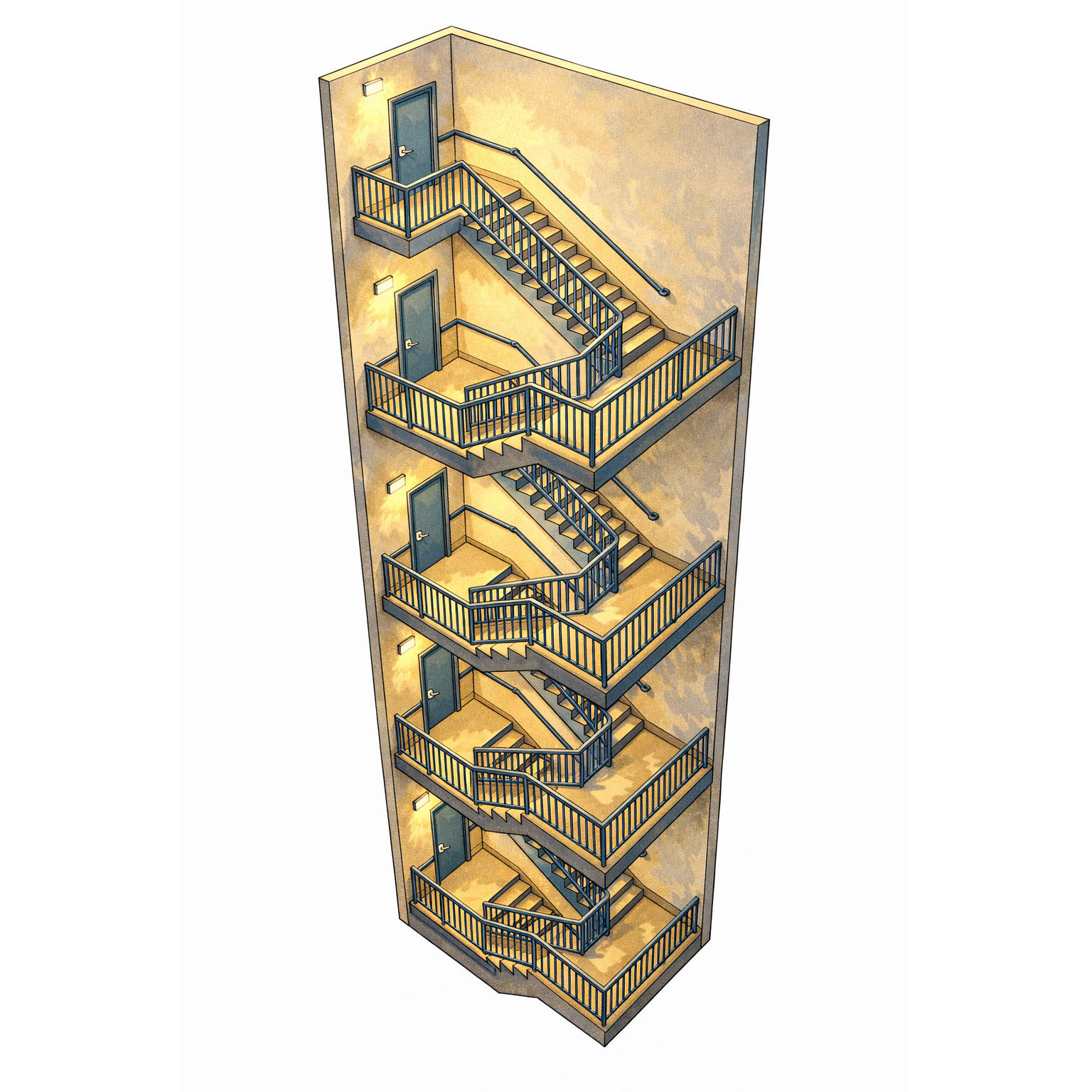
Single Means of Egress in Massachusetts: Not Radical — Already Rooted in Code
[ssba]Single Means of Egress in Massachusetts: Not Radical — Already Rooted in Code
Massachusetts is in the middle of a housing supply crisis. Land is scarce, parcels are narrow, and many urban sites are constrained by frontage, depth, or historic context. Yet one regulatory factor quietly shapes what can and cannot be built: the requirement for two means of egress in most multifamily buildings.
Recently, Governor Maura Healey launched an initiative to study the possibility of allowing single means of egress (SME) in certain larger residential buildings. For some, this sounds like a dramatic departure from life safety standards. It isn’t.
In fact, Massachusetts already permits single-stair buildings under defined conditions.
Existing Precedent in Code
1. Existing Building Code (IEBC)
Under the International Existing Building Code (IEBC), Massachusetts allows a single means of egress in taller buildings where the stair is pressurized and certain fire-resistance and sprinkler conditions are met.
The life-safety strategy is performance-based and relies on:
- Full NFPA 13 sprinkler coverage, fire-rated shaft enclosures, and protected compartmentalization
- Mechanical stair pressurization designed to prevent smoke migration
Redundancy is achieved through systems and engineering rather than duplication of stairs.
2. Three-Story Sprinklered Residential Buildings
Under the International Residential Code and related Massachusetts amendments, buildings up to three stories with full sprinkler systems and fewer than four dwelling units per floor may utilize a single means of egress.
These buildings perform safely because risk is mitigated through:
- Limited occupant loads and short travel distances
- Full sprinkler protection and modern detection systems
This is built precedent — not theoretical policy.
Why the Conversation Is Reopening
Many infill parcels in Massachusetts are narrow, setback-constrained, surrounded by existing structures, and located in walkable, transit-oriented districts.
A second stair often:
- Increases building width and reduces efficiency
- Eliminates units and makes small sites financially unviable
In some cases, it is the difference between 6 units and 9 units — a 50% increase in housing yield — without increasing building height.
SME could unlock missing-middle typologies such as:
- 4–8 unit courtyard or narrow-lot multifamily buildings
- Small condominium and compact transit-oriented developments
Safety Comes First
Modern buildings mitigate risk through:
- Protected or noncombustible assemblies, compartmentalized units, and hardwired detection
- Full sprinkler systems, pressurized stairs, and improved fire modeling
The question is not whether safety matters. It is whether safety can be achieved through engineered systems rather than spatial duplication.
The Real Constraint: Geometry
On small urban sites, two stairs:
- Consume disproportionate square footage and force inefficient double-loaded corridors
- Reduce daylight, cross-ventilation, and per-unit feasibility
If structured carefully, SME allowances could:
- Increase unit counts and improve workforce housing feasibility
- Support modest-scale developers while preserving smaller building footprints
Without changing height limits.
Without reducing fire protection standards.
Without compromising occupant safety.
This Is Not a Revolution
Massachusetts already permits:
- Single pressurized stairs in certain taller existing buildings
- Single-stair three-story residential buildings under sprinklered conditions
The discussion is about extension — not invention.
In a housing crisis defined by constrained land and constrained supply, geometry matters.
And sometimes, one stair — done correctly — is enough.